

A Side Quest
A Writer's Adventures at the World Cup

On a recent Saturday I found myself standing in South Station surrounded by men in kilts.
“Oh my gosh,” I said to my son, who is still small enough that a crowd of men in kilts appearing without warning seems par for the course. “Scotland made the World Cup!”
Like many (most) Americans of my generation, I grew up largely ignorant of the World Cup. But then I spent part of the summer of 1994 in a group of frenzied Brazilians clustered around a small television plugged via extension cord into a kitchen outlet in a house at the edge of a fragmented coffee field. By the time Brazil won the cup that year - I was watching on Telemundo back in Houston, alone, with no one screaming but me - I was captivated. I loved the elegance of the Brazilian style of play, I loved how relentless and hard won each goal was, and I loved that the entire world, outside of the United States, was watching together. And for the first time, the entire world included me.
When the World Cup rolled around again, in 1998, I was living in Paris studying art history. Paris was the host city, and while we couldn’t afford to go to any of the matches in person we watched them all on the television in the tiny bistro across the street from our even tinier apartment, cheering and drinking carafes of house wine and jumping up and down and screaming “Gooooooool!” That year the streets of Paris were flooded by the Tartan Army, men in kilts singing and chanting and putting traffic cones on statues. I felt like a world citizen in that moment. The World Cup, even more than the Olympics, is a global phenomenon, a global feeling. I loved it.
Now here was Scotland back again, competing for the World Cup for the first time since 1998, and they were playing in my city.
Their next game was against Morocco. On a Friday. And there were still tickets. They were ungodly expensive. But I could go, in theory. Should I go?
I took to Threads, a Twitter social media knockoff, with my dilemma.
“Go!” internet strangers urged me. “You can’t go when you’re dead!”
I swallowed hard and bought a ticket. Then I hurried to Amazon to obtain a kilt, with big enough pockets for a cell phone, in something close to a Magee tartan.
I was beside myself.

(Here I am in my cheapo Amazon tartan, with Doc Martens I hardly ever dust off.)
But there was a catch.
In my naivete, I had purchased my ticket on StubHub, a secondary resale marketplace, not from FIFA. Oops.
“We’re sorry,” a form email from StubHub informed me two days before the match. “But your ticket will not be available.” Whoever had pledged to sell me my ticket had reneged, presumably because after I bought it Scotland won their first match, and demand for tickets to the Morocco game doubled in price. StubHub offered me a refund instead.
Undaunted, I opened a chat window. I explained patiently that their guarantee said they would provide me with an equivalent ticket. They said they would not be doing that. I explained that they would. Then they closed the chat.
I telephoned. While on hold for forty-five minutes, I took my complaints to Threads. “Well, I made a crucial tactical error,” I said to what quickly ballooned to an internet mob of more than 54,000 strangers. “I bought my World Cup ticket for Scotland v. Morocco through StubHub. Today they messaged that my ticket was not available. Utterly shady. I am pulling out the velvet hammer.”
“The Velvet Hammer” is a method pioneered by my late mother. It entails a form of soft power in which you express your profound collective disappointment that you and the person you are speaking to find themselves together in this unfortunate circumstance. The customer service representative was unprepared for the degree of my thoughtful disappointment. Neither was her supervisor, who gave me not only his name but also his phone number as he attempted to solve my problem for me. But neither he nor I could have anticipated that my dilemma would invite the attention of the press.
“Remind me never to piss you off,” a friend remarked after the story went live.
StubHub in a panic asked the editor of the piece for my contact info, and my refund was processed with alacrity, which is apparently not what typically happens with them. I was resigning myself to watching the game at home in my new kilt when, on the morning of the match, I logged onto the FIFA site just to see.
They had a ticket. One. Last minute. In a great seat. For a little less than I paid StubHub.
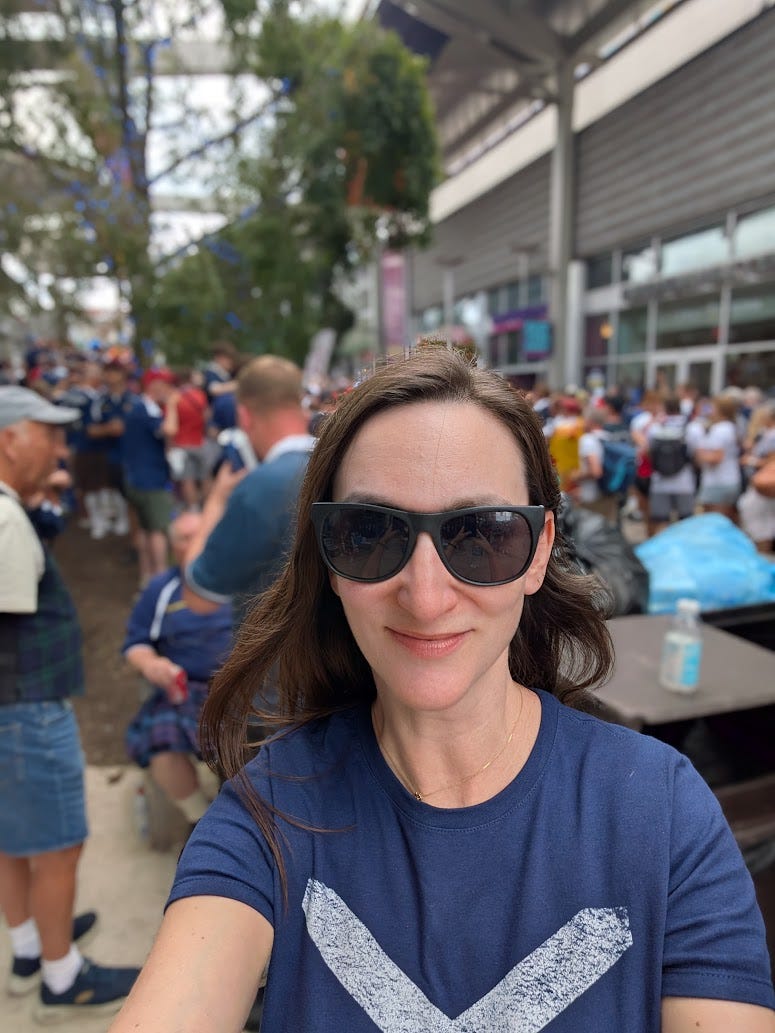
Friends, I went.
Snapshot impressions: singing “500 Miles” in a crowd draped with blue and white flags, spending too much money for a jersey for my son, running into my high school boyfriend and his family decked out half for Scotland, half for Morocco, bonding with a Morocco fan over our mutual need of a phone charger, Tartan Army chanting “No Scotland No Party!” as we made our way from the train to the stadium, workers passing out ice water as our lines snaked closer to security, Scotland fans singing “making your way to Massachusetts takes everything you got, getting a ticket to the World Cup sure does cost a lot” to the tune of the theme song from “Cheers,” streaming the opening ceremony and anthems via WhatsApp to my Scottish friend back in the UK as she watched in her pajamas, and Morocco scoring in the first five minutes (ouch). But what I will treasure is the feeling of being a global citizen. I am many regional identities: an American, a Texan, a New Englander. Rarely to I get to remind myself that I am a member of a global collective, to feel myself absorbed into a moment that connects me to people all over the planet.
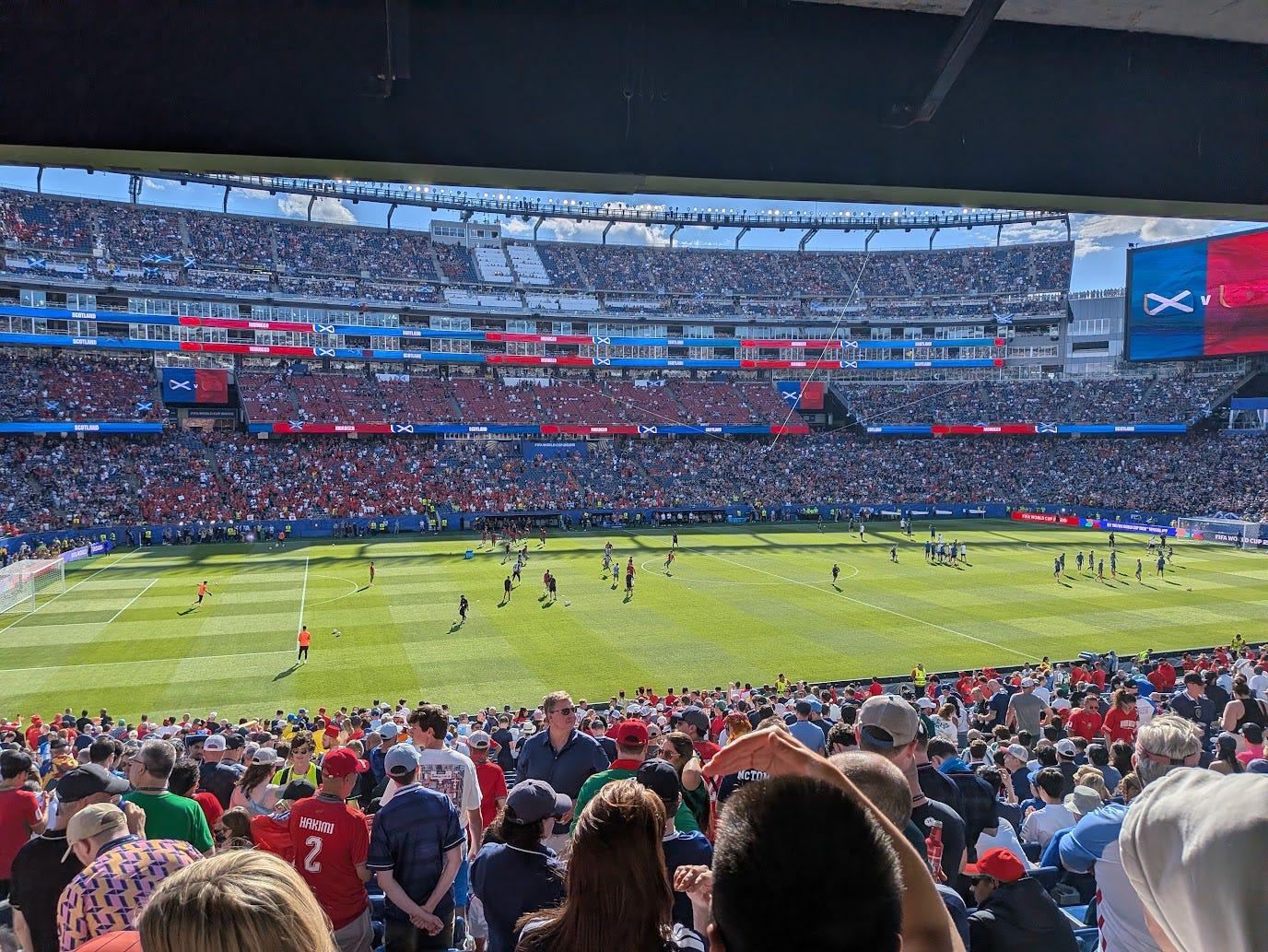
(I was also lucky that I got to sit in the shade.)
So what’s next?
I have finished an article, I’m getting started on my revamp of the Gilded Age novel, I’m sorting out my teaching schedule for the fall, and I’ve been doing a lot of sailing. It’s finally summer! I am writing this as I watch England play Ghana in Boston, and thinking, as I will for years to come, of the time I finally got to go to the World Cup.
Mere would be so proud of your perseverence, even though it's Scotland and not Ireland.
I grew up in Peabody (MA) in the 1950s. Down the street from us the Portuguese immigrants played soccer every Sunday.